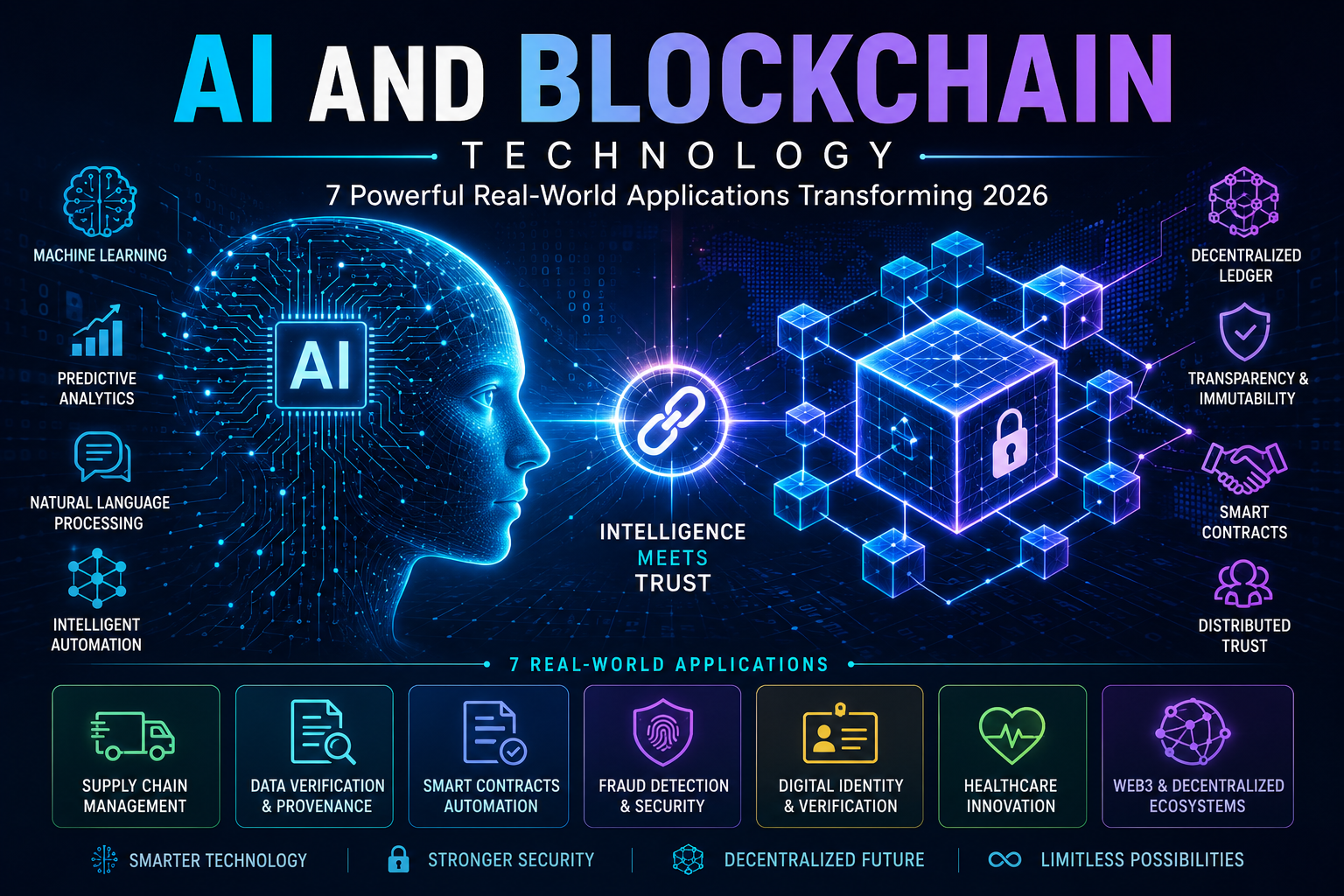
AI and Blockchain Technology: 7 Powerful Uses in 2026
Artificial intelligence is very good at finding patterns.
Blockchain is very good at maintaining records that are difficult to alter unnoticed.
Put those two ideas together, and something interesting happens.
One technology can help systems understand and act on data, while the other can help participants verify where important information came from and what happened to it.
That is why AI and blockchain technology has become an increasingly interesting area of technology research.
The combination is sometimes presented as though AI and blockchain automatically solve each other’s problems. Reality is more complicated.
Not every AI application needs blockchain.
Not every blockchain application needs artificial intelligence.
But when a business needs intelligent automation and multiple parties need trustworthy records, combining the technologies can make sense.
This guide explains how the two technologies can complement each other, where they are being explored in the real world, what their limitations are, and what their development could mean beyond cryptocurrency.
What Is AI and Blockchain Technology?
Before combining them, it helps to understand what each technology does.
Artificial intelligence is a broad field involving computer systems capable of tasks such as pattern recognition, classification, prediction, language processing, and decision support.
Machine learning, for example, allows systems to identify relationships in data rather than relying entirely on manually programmed rules.
Blockchain serves a different purpose.
The National Institute of Standards and Technology’s blockchain overview describes blockchains as distributed digital ledgers that are tamper evident and tamper resistant. Records are grouped into blocks and maintained through a distributed system rather than a single central repository.
That gives us a useful simplified distinction:
AI = intelligence and analysis
Blockchain = records, verification, and coordination
When those capabilities are combined appropriately, systems may be able to analyze information intelligently while maintaining verifiable records of important events.
IBM’s overview of blockchain and AI describes the convergence in terms of authenticity, augmentation, and automation.
That provides a useful starting point for understanding the relationship.
Introduction addition
As businesses search for better ways to analyze data while maintaining reliable digital records, AI and blockchain technology is becoming an important area of research across finance, supply chains, healthcare, cybersecurity, and digital identity.
What Is AI and Blockchain Technology?
At its core, AI and blockchain technology brings together two different capabilities: artificial intelligence can analyze and interpret information, while blockchain can help maintain verifiable digital records.
The value of AI and blockchain technology becomes clearer when organizations need both intelligent automation and greater confidence in the history of important data.
Supply Chain section
In supply chains, AI and blockchain technology can help organizations combine predictive analytics with shared records across manufacturers, logistics providers, distributors, and retailers.
This makes AI and blockchain technology particularly interesting for industries where traceability and operational intelligence are both important.
Data Verification section
Another potential benefit of AI and blockchain technology is improved data provenance. AI models depend heavily on trustworthy information, while blockchain can help document the history of selected records.
Smart Contracts section
The relationship between smart contracts and AI and blockchain technology is especially interesting because AI can support analysis while blockchain-based smart contracts can execute predefined rules.
Fraud Detection section
For fraud monitoring, AI and blockchain technology can combine machine-learning pattern detection with transparent transaction records.
Digital Identity section
Digital identity may become another major use case for AI and blockchain technology, especially where credential verification and automated risk analysis need to work together.
Healthcare section
Healthcare organizations are also exploring how AI and blockchain technology could support secure data coordination, consent tracking, and responsible analytics.
Web3 section
In Web3 environments, AI and blockchain technology could eventually support autonomous software agents, decentralized computing, digital payments, and machine-to-machine transactions.
Advantages section
The biggest advantage of AI and blockchain technology is not that the technologies are fashionable. It is that they can solve different parts of the same problem when intelligent analysis and trustworthy records are both required.
Challenges section
Despite its potential, AI and blockchain technology also introduces challenges involving privacy, scalability, accuracy, cybersecurity, costs, and regulation.
Future section
By 2030, AI and blockchain technology may play a larger role in digital identity, tokenized assets, decentralized AI infrastructure, data provenance, and automated economic systems.
Conclusion addition
The future of AI and blockchain technology will depend less on hype and more on whether developers can create practical systems that solve genuine business and consumer problems.
1. AI and Blockchain in Supply Chains
Imagine buying a bag of premium coffee.
The package tells you where the beans originated, perhaps the farm or region where they were grown.
But how does a customer know that information is accurate?
Supply chains involve farmers, manufacturers, logistics providers, warehouses, distributors, retailers, and customers. Information passes through numerous organizations.
Blockchain can potentially provide a shared record of important supply-chain events.
AI can analyze the information flowing through that system.
A Simple Example
Imagine a shipment of temperature-sensitive food traveling from a producer to a supermarket.
Sensors record temperature during transportation.
Blockchain records important checkpoints.
An AI system analyzes the sensor data.
Suppose the temperature suddenly moves outside the safe range.
AI could detect the anomaly.
The blockchain could provide a record showing when and where relevant events were recorded.
The combination does not magically guarantee that every piece of physical-world information is correct. Sensors can fail and inaccurate information can be entered.
But it illustrates the complementary roles of the technologies.
AI analyzes.
Blockchain records.
People investigate and act.
This isn’t purely theoretical. IBM’s AI supply-chain overview explains how AI is being used to process large datasets, predict trends and support operational decision-making. IBM also describes examples of blockchain and AI being used together in agricultural and supply-chain contexts.
Suggested internal link: How Blockchain Is Transforming Supply Chain Management
2. AI, Blockchain and Smarter Data Verification
Artificial intelligence has an enormous appetite for data.
That creates an obvious problem:
Can we trust the data?
An AI model trained on inaccurate information can produce inaccurate conclusions.
Blockchain cannot determine whether every fact entering a system is truthful. That distinction is essential.
What blockchain can potentially provide is a tamper-evident history of certain digital records.
Imagine a company training an AI system on information supplied by multiple organizations.
A blockchain-based record could potentially document:
- when a dataset was registered,
- which organization provided it,
- whether a recorded version changed,
- permissions associated with the information, and
- certain events in the data lifecycle.
This could become increasingly relevant as organizations seek better data provenance for artificial intelligence.
Human Example
Think of a school assignment.
A student writes:
“I found this statistic online.”
The teacher asks:
“Where did it come from?”
That second question is about provenance.
AI systems increasingly face a similar problem at a vastly larger scale.
Knowing the origin and history of information can be almost as important as possessing the information itself.
Suggested internal link: Blockchain Data Security Explained for Beginners
3. AI and Smart Contracts
Smart contracts are one of blockchain’s best-known applications.
A smart contract is essentially program logic deployed on a blockchain that can execute according to defined conditions.
Traditional smart contracts are generally deterministic.
They follow rules.
If condition X occurs, execute action Y.
Artificial intelligence introduces the possibility of more sophisticated decision-support systems surrounding smart contracts.
Imagine an insurance application.
A traditional smart contract might say:
If a verified flight is delayed by more than a defined period, process the agreed benefit.
AI could potentially operate outside the contract to analyze complex information, detect suspicious patterns, assess data, or help classify events.
The blockchain component can then handle predefined on-chain actions.
There is an important limitation, however.
Allowing unpredictable AI outputs to directly control irreversible blockchain transactions can create substantial risks.
AI models can make mistakes.
Smart contracts can contain bugs.
External data can be incorrect.
Therefore, combining the technologies requires safeguards, validation, security testing, and careful human oversight.
The exciting idea isn’t simply an “AI smart contract.”
It is building systems where intelligence and deterministic execution are used for the jobs they handle best.
Suggested internal link: What Are Smart Contracts and How Do They Work?
4. AI and Blockchain for Fraud Detection
Consider a payment network processing millions of transactions.
Human employees cannot manually inspect every transaction.
AI can analyze behavioral patterns and identify unusual activity.
For example, a system might notice that an account suddenly begins behaving very differently from its normal pattern.
That doesn’t automatically mean fraud occurred.
It means the activity may deserve investigation.
Blockchain can add another layer by providing a shared record of transactions or relevant events within a particular blockchain system.
The combination can be useful conceptually:
Blockchain provides the transaction history.
AI searches the history for unusual patterns.
Example
Imagine a digital marketplace where an account normally performs five small transactions each week.
Suddenly it begins making hundreds of unusual transactions.
A machine-learning system could flag the change.
Investigators could then examine the relevant blockchain records.
The AI isn’t the judge.
It is the pattern detector.
This distinction matters because automated fraud systems can generate false positives.
Human review may still be necessary for high-impact decisions.
Suggested internal link: How Artificial Intelligence Detects Cryptocurrency Fraud
5. AI and Blockchain for Digital Identity
Digital identity is becoming increasingly important.
People use online identities to access financial services, healthcare portals, government systems, educational platforms, workplaces, and digital marketplaces.
Traditional identity systems often store large amounts of information in centralized databases.
Blockchain-based identity approaches explore different ways of managing credentials and verification.
AI can potentially support these systems through:
- anomaly detection,
- document analysis,
- risk assessment,
- biometric matching,
- behavioral analysis, and
- automated verification assistance.
Imagine applying for access to a professional online platform.
Instead of repeatedly sending copies of the same qualification to different organizations, a digital credential could potentially be independently verifiable.
AI might help analyze a submitted document or detect suspicious behavior.
Blockchain could help support verification of an issued credential or its history.
Again, blockchain does not guarantee that the original credential was truthful.
The organization issuing the credential remains important.
Technology can strengthen verification processes, but it cannot eliminate the need for trustworthy real-world institutions.
Suggested internal link: Blockchain Digital Identity: A Beginner’s Guide
6. AI and Blockchain in Healthcare
Healthcare demonstrates both the potential and the complexity of combining these technologies.
Artificial intelligence can assist researchers and healthcare organizations in analyzing large datasets.
Blockchain can potentially help with controlled data sharing, record integrity, consent tracking, or coordination among organizations.
Imagine a research project involving several hospitals.
Each institution has valuable data.
But healthcare information is highly sensitive.
Organizations must think carefully about privacy, access, security, regulation, and patient consent.
A blockchain architecture could potentially record permissions or important data-sharing events without placing sensitive medical information directly on a public blockchain.
AI systems could then analyze appropriately authorized datasets.
The crucial phrase is appropriately authorized.
Putting private medical information onto an immutable public ledger could create serious privacy problems.
The best technology architecture is not necessarily the one using the most blockchain.
It is the one that solves the problem safely.
That principle applies throughout AI and blockchain technology.
Suggested internal link: Blockchain in Healthcare: Benefits, Risks and Applications
7. AI, Blockchain and the Future of Web3
Perhaps the most futuristic intersection involves decentralized digital infrastructure.
Web3 is a broad term, but one idea behind it is reducing dependence on centralized intermediaries for certain digital activities.
Artificial intelligence creates another interesting question.
Who owns the models?
Who provides the computing power?
Who owns the data?
Who gets paid when AI agents transact?
Blockchain-based networks are being explored as possible infrastructure for decentralized computing, digital ownership, machine-to-machine payments, identity, and coordination.
Imagine an AI agent authorized to purchase a small amount of computing capacity.
The agent identifies an available resource.
A blockchain system handles a payment or records the transaction.
The AI then uses the resource to complete a task.
That sounds futuristic, but it illustrates why the intersection is receiving attention.
The next generation of the internet could potentially include software agents capable of interacting economically with digital networks.
Whether those systems become mainstream will depend on cost, security, regulation, scalability, and whether they provide meaningful advantages over centralized alternatives.
Suggested internal link: AI and Web3: Understanding the Future of Decentralized Technology
A Real-World Example: Agriculture
One of the best ways to understand the AI-blockchain combination is through agriculture.
A farmer produces coffee.
Information can be generated about growing conditions, quality, harvesting, transportation, processing, and sale.
AI can analyze agricultural information to support decisions.
Blockchain can maintain shared records across participants in the supply chain.
IBM has described work involving Heifer International where blockchain technology and AI-supported agricultural decision tools were used in the context of coffee and cocoa growers.
This is useful because it demonstrates that AI and blockchain technology isn’t limited to cryptocurrency trading.
Its potential applications can involve physical products and ordinary businesses.
A cup of coffee may not look like advanced technology.
Behind it, however, there may be a complex digital chain of information.
Another 2026 Example: Supply-Chain Analytics
Supply chains are generating more data than many organizations can comfortably interpret manually.
In a March 2026 overview, IBM described supply-chain analytics as bringing together data to understand what is happening, why it is happening, and what may happen next. Examples include identifying delivery delays, supplier risks, demand patterns and inventory problems.
Now imagine combining those analytical capabilities with selected blockchain records.
The blockchain doesn’t perform the prediction.
AI doesn’t provide the immutable ledger.
Each technology performs a different function.
That separation is one reason the combination is interesting.
The Biggest Advantages of Combining AI and Blockchain
The potential benefits depend heavily on the application, but several themes appear repeatedly.
Data provenance: Blockchain may provide evidence about the history of selected records.
Automation: AI can interpret information while smart contracts can automate predefined actions.
Shared records: Multiple organizations may coordinate around a common ledger.
Pattern detection: AI can identify unusual activity in large datasets.
Transparency: Certain blockchain systems can make transaction histories easier to audit.
Decentralized coordination: Blockchain can enable participants that do not share one central database to coordinate according to common rules.
But none of these benefits should be assumed automatically.
A poorly designed blockchain system remains poorly designed.
A weak AI model remains a weak AI model.
Combining them does not remove those weaknesses.
Challenges of AI and Blockchain Technology
An educational article needs to discuss the problems as seriously as the opportunities.
Scalability
AI systems can process enormous datasets.
Public blockchains may have significant constraints around transaction throughput, latency and storage.
Trying to put every piece of AI data directly onto a blockchain is usually unrealistic.
Privacy
AI benefits from data.
Blockchain can preserve records for long periods.
That combination creates obvious privacy questions.
Sensitive information needs careful handling.
Cost
Running sophisticated AI infrastructure can be expensive.
Blockchain transactions and infrastructure can also have costs.
A combined solution needs to provide enough value to justify its complexity.
Accuracy
AI can hallucinate, misclassify information, or produce incorrect predictions.
Blockchain can preserve a record, but it cannot make an incorrect AI conclusion magically correct.
The Oracle Problem
Blockchains often depend on external information.
If incorrect real-world information enters the system, an immutable record may simply preserve incorrect information.
Regulation
AI and blockchain are both areas receiving substantial regulatory attention around the world.
Systems involving financial services, identity, healthcare, or personal information may face particularly demanding compliance requirements.
Does Every Business Need Blockchain and AI?
No.
This may be the most important lesson in the entire article.
A normal database is sometimes better than a blockchain.
A simple statistical model is sometimes better than an advanced AI system.
A human employee is sometimes better than either.
Technology should solve a real problem.
It should not be added merely because the words “AI” and “blockchain” sound modern.
A company should ask:
Does this problem require multiple parties to share records?
Is tamper evidence important?
Would intelligent analysis provide meaningful value?
Can the system protect privacy?
Can the organization justify the cost?
If the answer to those questions is no, a simpler architecture may be better.
That kind of critical thinking is essential as these technologies mature.
What Could AI and Blockchain Look Like by 2030?
Nobody can know with certainty.
But several developments are plausible.
AI agents may become more capable of interacting with digital economic systems.
Blockchain networks may increasingly be used for tokenized assets, credentials, digital ownership and machine-to-machine coordination.
Data provenance may become more important as AI-generated content becomes harder to distinguish from human-created information.
Organizations may also demand stronger records showing where AI training data originated and how automated decisions were produced.
At the same time, many projects will probably fail.
That is normal in emerging technology.
The long-term winners are unlikely to be products that simply advertise “AI + Blockchain.”
They will be products where users barely notice the underlying technologies because the technologies solve a genuine problem.
Frequently Asked Questions
What is AI and blockchain technology?
AI and blockchain technology refers to systems that combine artificial-intelligence capabilities such as pattern recognition, prediction or language processing with blockchain capabilities such as distributed record keeping, cryptographic verification and transaction coordination.
How can AI and blockchain work together?
AI can analyze information and identify patterns, while blockchain can maintain records of selected transactions, data events, credentials or permissions. Their exact roles depend on the application.
Is blockchain a form of artificial intelligence?
No. Blockchain and AI are separate technologies. Blockchain primarily concerns distributed records and consensus, while AI focuses on computational intelligence, pattern recognition and automated analysis.
Can blockchain make AI more trustworthy?
Blockchain may improve provenance or auditability for certain data and events, but it cannot guarantee that an AI model is accurate or unbiased. Trustworthy AI requires much more than blockchain.
Can AI improve blockchain security?
AI may assist with anomaly detection, fraud analysis and monitoring. However, AI cannot eliminate smart-contract vulnerabilities, stolen credentials, poor security practices or other blockchain risks.
How are AI and blockchain used in supply chains?
AI can analyze demand, inventory, logistics and operational information. Blockchain can provide shared records among supply-chain participants. Together they may support analytics and traceability where the architecture is appropriate.
Are AI and blockchain used outside cryptocurrency?
Yes. Blockchain technology can have applications beyond cryptocurrency, including supply chains, records management, digital identification and data registries. NIST specifically identifies several such potential application areas.
What are the risks of combining AI with blockchain?
Important challenges include privacy, scalability, cost, inaccurate AI outputs, poor external data, cybersecurity vulnerabilities and regulatory requirements.
Will AI and blockchain replace traditional databases?
Not generally. Traditional databases remain better suited to many applications. Blockchain is most useful when its particular properties solve a genuine coordination or record-integrity problem.
What is the future of AI and blockchain?
Potential areas include decentralized AI infrastructure, digital identity, supply-chain analytics, smart-contract automation, tokenized assets, data provenance and AI-agent transactions. Adoption will depend on whether these systems provide practical advantages over simpler alternatives.
Final Thoughts
Artificial intelligence and blockchain solve fundamentally different problems.
That is precisely why combining them can be interesting.
AI can transform enormous datasets into classifications, patterns, predictions and useful insights.
Blockchain can help multiple participants maintain shared, tamper-evident records.
Together, they create the possibility of digital systems that are both more intelligent and more verifiable.
But enthusiasm should always be balanced with practical thinking.
Not every problem needs AI.
Not every problem needs blockchain.
And adding both technologies to a product does not automatically make that product innovative.
The strongest applications of AI and blockchain technology will be the ones where each technology has a clearly defined purpose.
A supply chain may use AI to anticipate disruption and blockchain to maintain selected shared records.
A digital-identity platform may use AI to detect suspicious activity and blockchain to verify credentials.
A future AI agent may analyze information independently while using blockchain infrastructure for a transaction.
The details will differ.
The underlying principle remains the same:
AI can help systems understand. Blockchain can help systems verify.
Understanding how those capabilities complement—and sometimes conflict with—each other will be increasingly valuable as both technologies continue to evolve.
Educational Disclaimer: This article is provided for educational and informational purposes only. It does not constitute financial, investment, legal, cybersecurity, or professional advice. Readers should independently evaluate technologies, services, investments, and business decisions.
- AI and Blockchain Technology: 7 Powerful Real-World Applications Transforming 2026
- Blockchain Technology Explained in 2026: The Ultimate Beginner’s Guide to Distributed Ledgers, Smart Contracts, and Real-World Applications
- ⛓️ AI Blockchain Interoperability in 2026: The Silent Revolution Connecting the Digital World
- ⛓️ AI Blockchain Security in 2026: The Hidden Digital War Most People Never See
- ⛓️ AI Blockchain Investments 2026: The Educational Guide to Smarter Digital Finance Opportunities
Table of Contents
I and blockchain technology combines intelligent automation with decentralized, tamper-resistant digital records, powering real-world applications in supply chains, smart contracts, fraud detection, digital identity, healthcare, and Web3.

Leave a Reply